Article
Beyond Pull Requests: How I Review AI-Generated Work
When AI agents write the code, reviewing a diff is no longer enough. Here's how I'm changing my approach to software delivery.
In Everything Changed. Nothing Really Changed., I explained how my daily work has shifted from writing code to preparing the environment in which AI agents can work.
But that raises an important question: how do I know they’ve actually done a good job?
I still own the result. If an agent produces code that ends up in production, I consider myself responsible for it, just as I was responsible for the code delivered by my team when I was a Tech Lead.
The difference is the amount of code an agent can produce while I’m doing something else. And that’s where my old code review habits started to feel insufficient.
A Pull Request I Still Remember
A few years ago, while working on a project at SWIFT, I spent roughly three days reviewing a huge pull request.
The developer had built a dependency injection mechanism from scratch, even though we were using Spring Boot. Instead of relying on the framework, we now had our own little framework to understand and maintain.
I remember going through the changes, trying to understand the decisions, and discussing the implementation. In the end, we merged it with a TODO to refactor it later. Of course, that refactoring never happened. It wasn’t exactly my favorite review.
But it taught me something. A pull request can be technically reviewable and still be the wrong level at which to discover a problem. By the time you’re reading hundreds of changed lines, some important design decisions have already been made.
With AI agents, that problem becomes even more visible. They can generate a large implementation quickly. A massive diff doesn’t necessarily mean weeks of work anymore.
So if my review process is still just open the PR, read every line, approve, I’m going to become the bottleneck.
Code Review Was Never Just About Finding Bugs
I don’t want to give up code reviews. They’ve always been one of my favorite ways to learn.
I encouraged junior developers to review code written by senior developers, not just the other way around. Asking questions about a design or a piece of code is a great way to understand why something was built in a particular way.
And I still learn things from AI-generated code. Agents have introduced me to tools and techniques I hadn’t used before, such as ArchUnit, dedicated testkit modules to share test utilities instead of Maven test-jars, or different ways to structure logging with MDC. That’s useful. I don’t want to lose that opportunity.
But I also don’t believe that reading every generated line is the only way to be accountable for the result. I need to understand what was built, why it was built that way, how it behaves, and what evidence supports the claim that it works. Those are related questions, but they aren’t all answered by a Git diff.
What I Actually Want to Review
Imagine I ask an agent to implement a feature. When it’s done, I don’t want the first thing I see to be a list of 27 modified files.
I’d much rather start with a simple explanation: What does this feature do? What changed for the user? What are the important decisions? Then I want evidence. Did the tests pass? Did the CI pipeline succeed? Were there any quality issues? Can I see the feature working? If it’s a frontend change, can I see screenshots instead of trying to imagine the UI from React components?
If it’s an API or a backend workflow, a small sequence diagram might help me understand the interactions. But I don’t need ten diagrams for every task. Two or three, when they actually add value, are more than enough.
And if an agent changed documentation, I want to see the rendered Markdown, not only the raw diff.
I had a perfect example while writing this article. I asked an agent to blur my ACC screenshots before publishing them. Later, I asked it to redo the report screenshot as a full page. Instead of editing my image, it took a new capture of its own, and it wasn’t blurred.
Everything looked fine. The build passed, the CI was green, and the report said Verified. In the pull request, the change was one line: Bin 299217 -> 609389 bytes.
No diff will ever tell you what’s inside a picture. I only caught it because I looked at the image.
The idea isn’t to hide the code. It’s to start with the behavior and the evidence, and then dive into the implementation where it matters.
A good report should help me decide what deserves a closer look, not bury me under another mountain of automatically generated text.
My Agent Control Center
This is what I use my Agent Control Center (ACC) for: a place where I can follow my agents and review what they deliver at the end of a task.
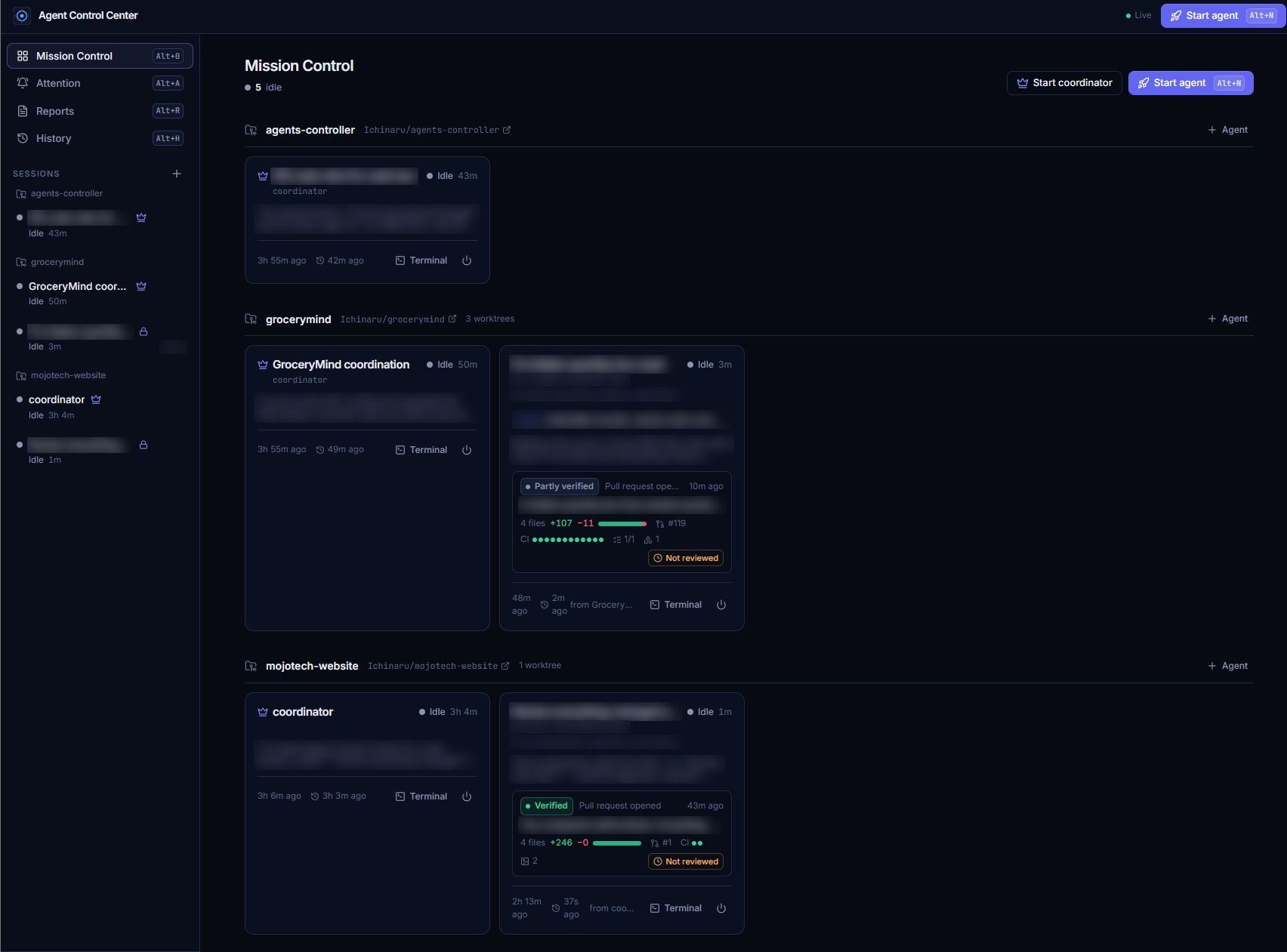
The delivery report brings together the changed files, test results, CI pipeline status, and explanations of what was implemented. I’m also experimenting with screenshots, rendered documentation, quality metrics, and diagrams that help explain the feature.
And ACC doesn’t simply trust the agent’s report. It checks each claim against Git, the CI pipeline and the test runs it actually saw, and shows the evidence next to what the agent says.
A good report is also honest about what it couldn’t check. My agents run in a sandbox that can’t reach the live environment, so a recent GroceryMind fix came with “Not checked on the live site.” That’s not a failure. It tells me exactly what I still need to verify myself.
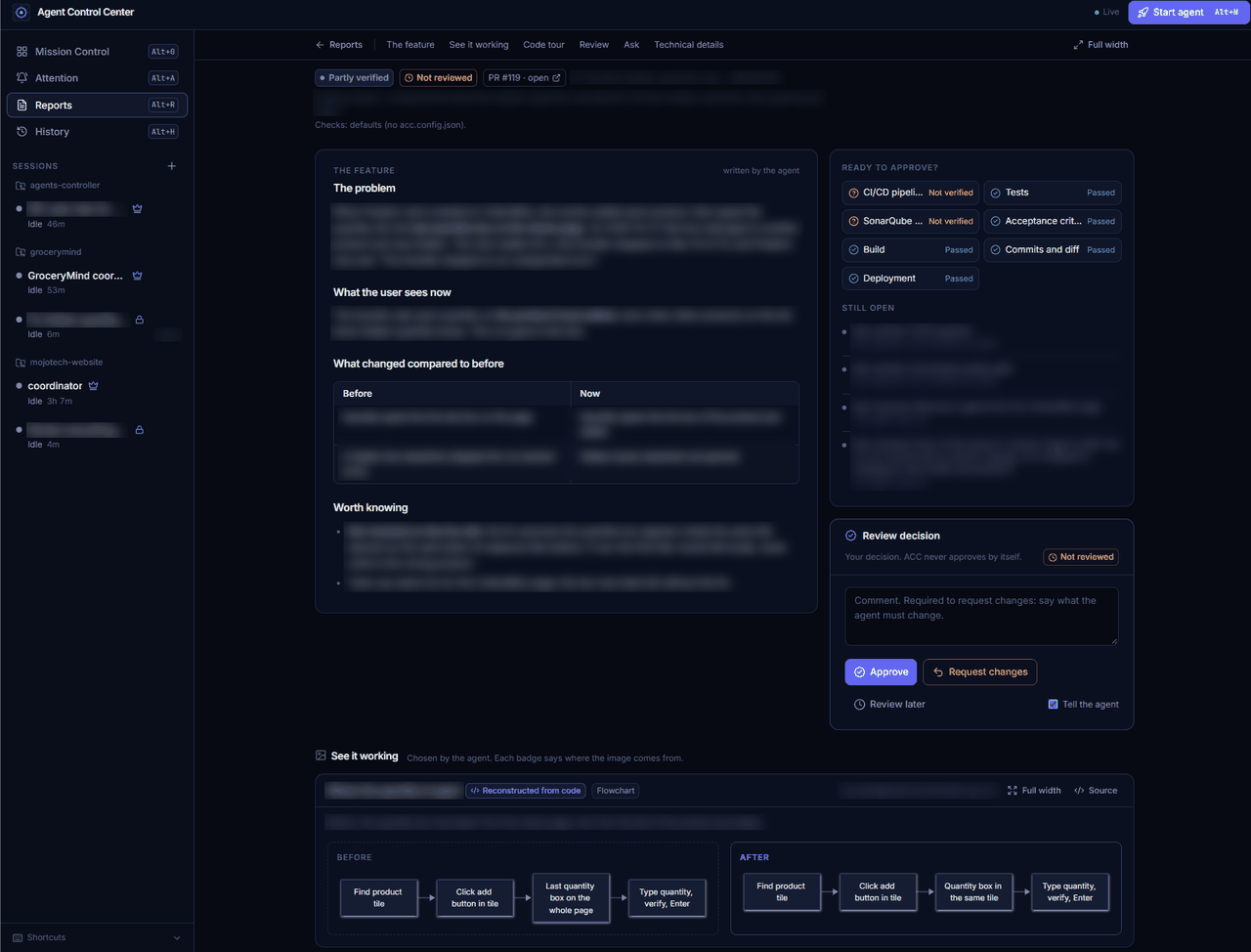
It’s still evolving. Some reports have too much detail. Some diagrams don’t really help. And sometimes the most useful improvement is simply removing information rather than adding another widget.
But that’s part of the experiment: finding the smallest amount of information that allows me to understand the change and make a good decision.
Don’t Let the Agent Grade Its Own Homework
There’s another issue I keep coming back to. An agent can implement a feature, write the tests, run them, and tell me everything is green.
That’s useful, but there’s a limitation: the same agent may have misunderstood the requirement and written tests that confirm its own misunderstanding.
A green test suite is evidence that the implementation satisfies those tests. It isn’t proof that we built the right thing.
This is why I now use a separate QA agent in GroceryMind. The implementation agent builds the feature, while the QA agent works from the requirements: it writes the test scenarios and implements them. And it can’t read the code.
Here’s a real example from GroceryMind. While preparing test scenarios, my QA agent noticed that the application accepted quantities like 0.5, but the background worker processing the shopping list rejected anything below 1. Worse, it silently discarded the entire message.
The QA agent caught the mismatch while designing the checks, before running them. The issue was passed back to the development agent, which fixed it.
That’s the kind of problem I want independent QA to uncover: not necessarily a failing unit test, but two parts of the system making different assumptions about the same requirement.
Two agents can still make the same mistake, of course. Independence doesn’t magically guarantee correctness. But it reduces the risk of accepting an implementation simply because its own tests agree with it.
And this isn’t a new idea either. It’s the same reason we distinguish implementation from acceptance testing, and why a second pair of eyes can be valuable.
That last part is important. If the QA agent could read the implementation, it would be tempted to repeat its assumptions. Without the code, its only path is back to the requirements.
The Review Starts Before the Pull Request
Looking back at that dependency injection PR from my SWIFT days, I think the most useful review would have happened before the code existed. A short discussion about the design might have prevented three days of reviewing an implementation we didn’t really need.
The same applies to agents. If I give an unclear requirement to an agent and only inspect the result at the end, I shouldn’t be surprised when it builds something different from what I had in mind.
That’s why I increasingly care about the steps before implementation: clear requirements, scope, architecture decisions, and the right automated checks.
A pull request is still useful. I still want branches, reviews, CI and protection rules. But the PR becomes one part of a wider delivery process, not the single place where all quality decisions happen.
I want to review the intention early, the behavior when it’s delivered, the evidence that it works, and the code when I need to understand or challenge the implementation.
Still Responsible for the Code
I don’t think AI agents remove the responsibility of the engineer. If anything, they make that responsibility more important.
The agent can write code faster than I can review every line. So my job is to build a review process that scales without turning quality into a checkbox.
That means better requirements, independent validation, useful reports, and knowing when to go deeper into the code. It also means accepting that my tools and process will keep evolving as I learn what works.
I haven’t stopped caring about code. I’m just trying to spend more of my review time on the questions that matter most: Did we build the right thing? Does it work? And can I confidently take responsibility for it?